Nintendo Switch Pro Controller
How RenHDrum dismantled coarse "helicopter rumble" and swallowed button inputs to achieve authentic high-definition dual-band haptics on physical Linear Resonant Actuators across both wired USB and wireless Bluetooth.
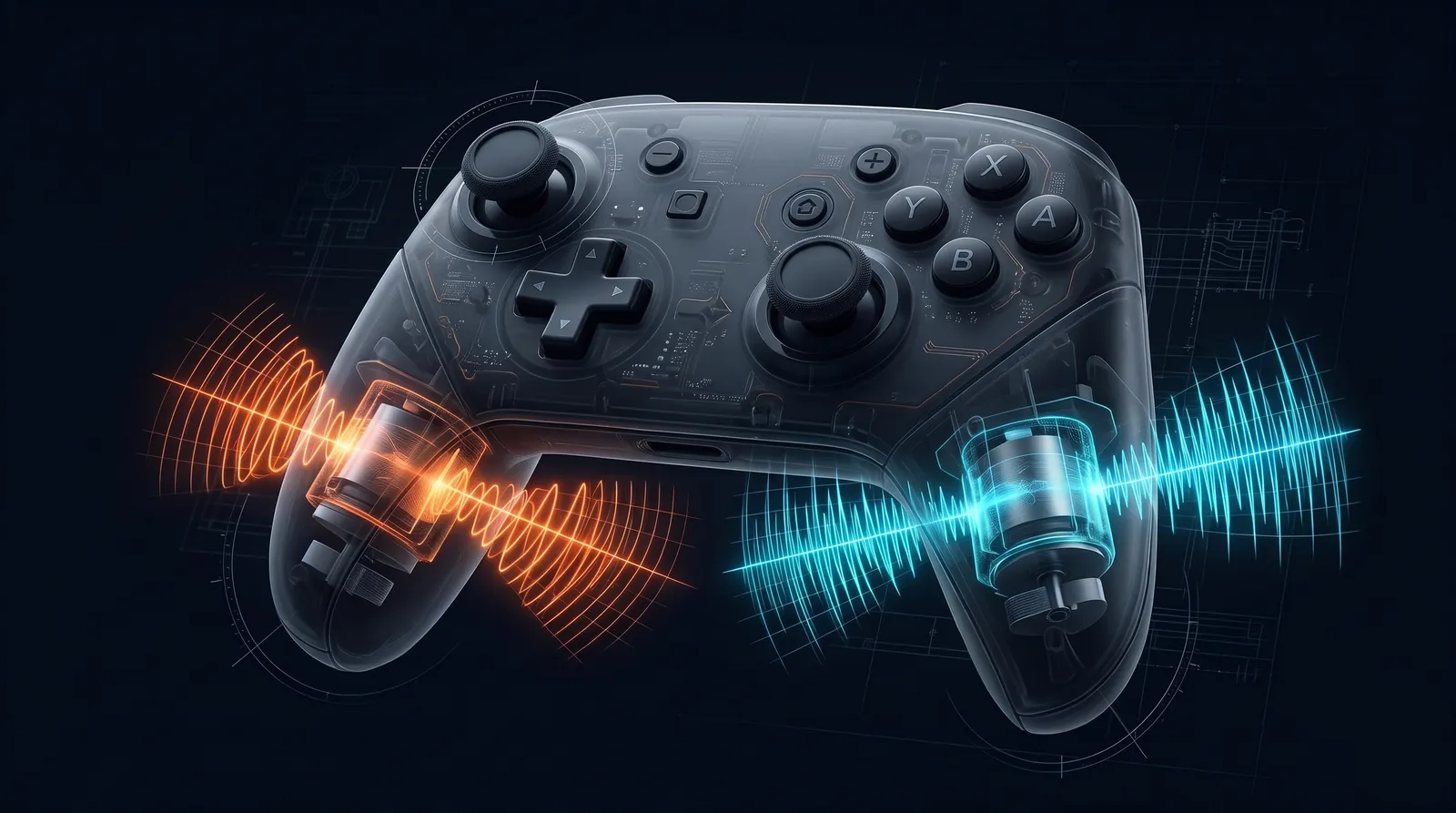
From "Helicopter Rumble" & Swallowed Inputs to the Gold Standard
During early testing in October 2026, playing titles with nuanced musical haptics revealed a frustrating reality: gamepads vibrated with a crude, deafening drone that felt like a miniature helicopter trapped inside the chassis, while quick button presses during intense boss battles or platform jumps were periodically swallowed into the void.
Dissecting upstream SDL2 (2.30.x) unmasked three fatal architectural bugs: (1) SDL's Switch driver unconditionally returned "unsupported" for vibration calls, causing emulators to either fallback to blunt ERM motor emulation or fail completely; (2) Bluetooth Switch controllers were incorrectly categorized as USB devices (bus 0x03), triggering bloated USB packet bursts over a radio link; and (3) most egregiously, SDL's input polling loop completely skipped reading controller buttons whenever there was a vibration packet pending in the queue (rumble_pending > 0)!
RenHDrum began as a refusal to accept that compromise: decoupling vibration transmission from the critical input polling loop, eliminating packet backlogs, and reverse-engineering the native silicon communication commands from the ground up.
Subcommand 0x10 & the 5 ms Multi-Sample Planner
How RenHDrum maps 15 ms emulation frames into 3 sub-frame micro-timing slots using dekuNukem's lookup tables and physical spectrogram measurements.
01 Switchbrew Framing Formats
Switch hardware packs vibration into 3 distinct micro-timing modes: FormatThree (three 5-bit amplitude slots 3..11 with hold code 24), FormatThree7bit (7-bit full frequency + 2 subsequent 5-bit slots), and FormatTwo14bit (14-bit high precision frequency jump codes).
02 Energy Compensation Constant
MegaCadeDev's PR #116 discovered that 5-bit logarithmic amplitude codes have a -0.84375 energy offset compared to 7-bit peak indices. RenHDrum applies the exact multiplier Code5GameScale = 1.7947091 (2^0.84375), strictly equalizing acoustic volume across 1-sample and 3-sample packets.
03 Acoustic Spectrogram Tuning
On October 17, 2026, by physically placing a smartphone microphone against the vibrating gamepad and analyzing acoustic spectrograms, we experimentally decoded frequency preset codes (12..16: -12, -6, 0, +6, +12 steps) and step codes (23, 25). This slashed the fallback rate to coarse 2-wave packets from 62% down to just 12%!
04 Sub-5-Bit Floor Recovery
When games request very quiet continuous rumble (e.g. ambient wind at amplitude 0.001–0.038), all 3 slots round to code == 0 under 5-bit quantization. RenHDrum checks if no_level && felt: falling back to 7-bit 2-wave encoding below SILENT_BELOW = 0.04 to preserve delicate micro-haptics.
Crisp Notes Algorithm & Coil Protection
How RenHDrum turns sluggish LRA coils into snapping tactile speakers without overheating hardware.
Linear Resonant Actuators are suspended masses with physical momentum: they take several cycles to ramp up from rest, and once vibrating, they ring out after the drive signal stops. This creates "mushy" notes where crisp musical chords blur together.
In src/encoding/crisp_notes.rs, RenHDrum implements transient pre-emphasis: when a new vibration begins from silence, the first 2 slots (10 ms) receive an accent boost of +3 dB (ACCENT_GAIN = 1.41) to overcome mechanical inertia instantly. For the subsequent 6 slots (30 ms), a damping dip of -3 dB (DIP_GAIN = 0.71) suppresses ringing before settling into the game's target amplitude.
To safeguard the physical voice coils from excessive excursion, the algorithm clamps total combined power so that amp_low + amp_high <= 1.0 under all transient multiplier conditions.
Zero-Lag USB & Bluetooth Transports
Solving the physical transport bottleneck across wired USB endpoints and Broadcom CYW20734 Bluetooth radio silicon.
USB Idle-Gated No-Queue (15 ms)
Checks atomic flag rumble_busy before issuing HID writes. If the bus is transmitting, incoming samples merge their peak amplitudes via HDSync_MergeSide rather than piling up in a FIFO queue. Sliding window detector (HdDenseDetector) automatically relaxes pacing from 15 ms to 30 ms if a game floods ≥ 90 packets/sec.
BT B1 Write-After-Input Pacing
The Switch Pro's CYW20734 radio is half-duplex: transmitting while the controller is broadcasting input packets causes immediate radio collision and packet drops. RenHDrum's B1 card listens for the input packet first and transmits immediately afterward, maintaining a rock-solid 20 ms floor (HD_RUMBLE_BT_WRITE_MS).
BT B3 3-Tier Token Bucket (HD_BT_LEVELS)
Enforces strict transmission budgets: Level 1 (60 ms / burst 2 / refill 100 ms), Level 2 (45 / 3 / 80), and Level 3 (35 ms / 4 burst / 65 ms refill). Neutral stop packets carry stop_priority, bypassing bucket rate limits to instantly silence motors when in-game actions end.
BT Keep-Alive 150 ms Refresh Cycle
Standard SDL Bluetooth stacks blindly spam refresh packets every 50 ms. RenHDrum extends keep-alive intervals to 150 ms (HD_RUMBLE_BT_REFRESH_MS), reducing wireless RF traffic by 66.7% while keeping controller watchdogs alive.