PlayStation DualSense Audio VCM Haptics
How RenHDrum translates 2-band Switch HD Rumble telemetry into a continuous 48,000 Hz 4-channel audio stream, driving physical stereo Voice Coil Motors with psychoacoustic power curves and bit-exact golden waveforms.
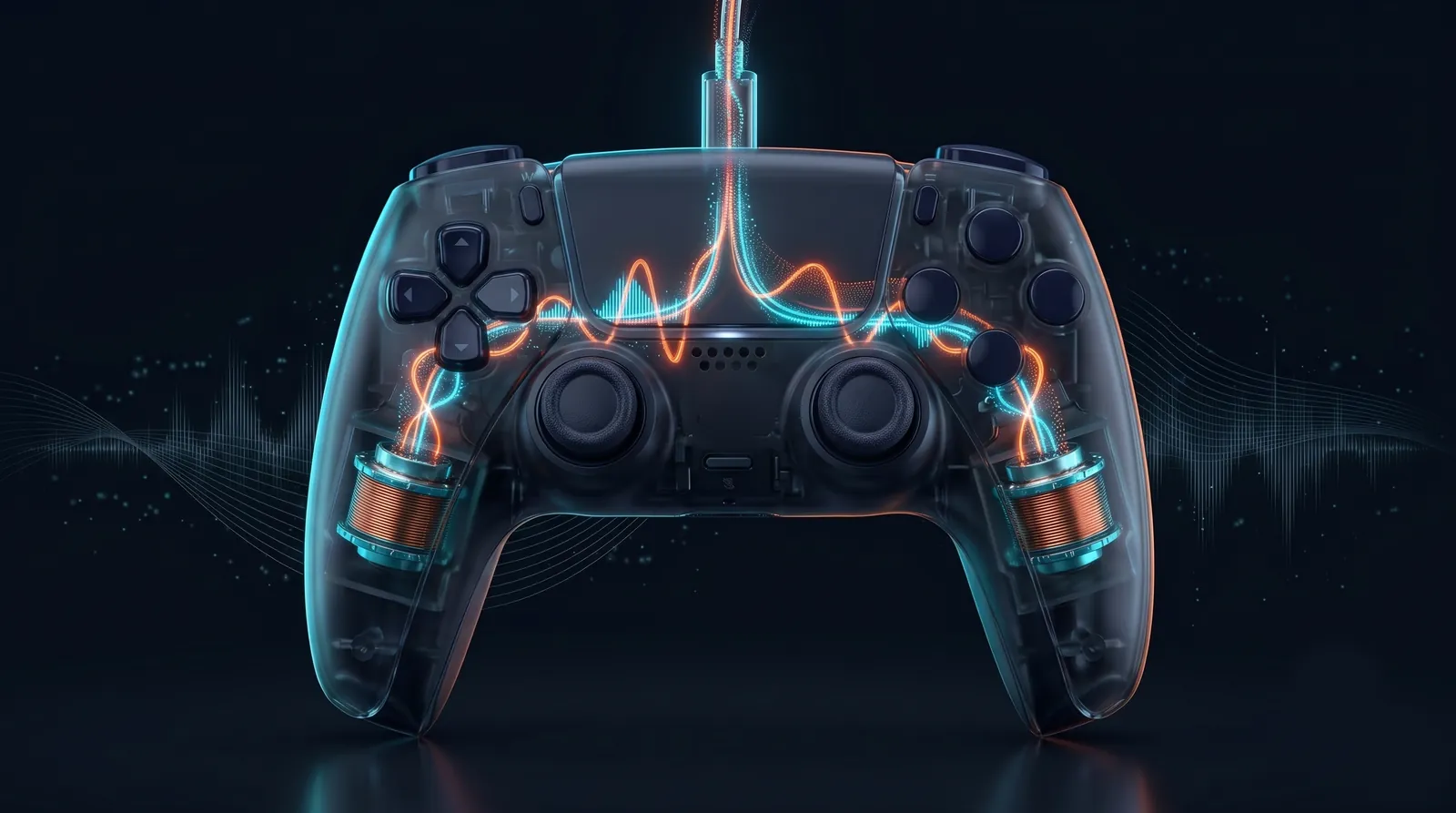
Teaching a PlayStation Controller to Speak Switch HD Rumble
On October 13, 2026 (release 0.1.9), RenHDrum welcomed the PlayStation DualSense into its tactile ecosystem. Unlike legacy gamepads with coarse eccentric rotating masses (ERM) that can only spin faster or slower, the DualSense is equipped with stereo Voice Coil Motors (VCM)—essentially miniature full-range tactile speakers that accept raw audio signals directly over USB.
The Bold Decision (October 18, 2026 — release 0.2.6.1): Early experimental builds tested 10-zone adaptive triggers (0x02 report) alongside audio haptics. However, practical playtests proved that motorized trigger resistance quickly fatigued fingers and broke concentration during intense gameplay. The project made the brave choice to formally retire Adaptive Triggers, channeling 100% of engineering bandwidth into perfecting USB Audio VCM Haptics.
Overcoming 4 OS & Audio Traps
Why connecting a DualSense to an emulator requires surgical handling of audio subsystems and channel counts.
01 Audio Subsystem Dormancy
Emulator input drivers only initialize joystick HID systems, leaving SDL_INIT_AUDIO uninitialized. RenHDrum explicitly checks and invokes SDL_InitSubSystem(SDL_INIT_AUDIO) whenever a DualSense gamepad is plugged in.
02 WASAPI Detection Delay
On Windows, the DualSense audio endpoint takes hundreds of milliseconds (and up to 12 seconds) longer to enumerate than the HID endpoint. RenHDrum's MaintainDualSenseAudio routine retries opening the audio stream every 2 seconds (up to 10 attempts) automatically.
03 Stereo Downmix Trap
If an emulator opens an audio device without verifying channels, Windows / SDL quietly downmixes channels 3–4 into stereo channels 1–2, blasting harsh vibration waveforms out of the gamepad's headphone jack into player ears! RenHDrum strictly verifies dev_spec.channels >= 4 before streaming.
04 HID Motor Collision
If standard HID rumble continues running while VCM audio streams, the coarse legacy motor commands collide with the subtle acoustic waveforms. RenHDrum immediately sends SDL_RumbleJoystick(0, 0, 0) to permanently silence HID motors upon opening the audio stream.
Wired USB (Audio Class 2.0)
48 kHz Float32Windows opens the DualSense as a 4-channel audio device over USB. RenHDrum streams 48 kHz float audio directly to channels 3 & 4, driving the voice-coil subwoofers with full dynamic range. Supported in Brontide & Ryuhdr.
Wireless Bluetooth (Report 0x32)
3 kHz PCM HIDOver Bluetooth, Windows cannot see DualSense audio endpoints. RenHDrum packages haptics into HID report 0x32 (s8 3 kHz PCM) sent ~94 times/sec. Supported in Brontide • coming soon to Ryuhdr.
The Mathematics of Real-Time VCM Synthesis
Power Curve x^0.5 (DUALSENSE_AMPLITUDE_EXPONENT = 0.5): Human skin perception of mechanical vibration is non-linear. The square root curve lifts whisper-quiet tactile events (such as walking through grass or gentle water ripples) above the mechanical deadzone of the VCM coils without distorting loud explosions.
Dual Overload Clamping & 0.8 Ceiling (DUALSENSE_OUTPUT_CEILING = 0.8): If low and high bands exceed 1.0 combined, RenHDrum scales both proportionally, then clamps output to 0.8 to ensure the voice coils never strike their mechanical end-stops.
1-Pole 4 ms Smoothing (DUALSENSE_SMOOTHING_MS = 4.0): Transitions in frequency (20–1000 Hz) and amplitude glide smoothly across a 4 ms time constant using 64-bit float phase accumulation, guaranteeing zero audible pops or clicks.
Invariant 256-Frame Crisp Notes & Golden Waveform
How RenHDrum decoupled micro-timing from OS audio buffer sizes and verified bit-exact DSP parity against Ryuhdr.
While legacy SDL2 always requested audio in fixed chunks of 256 frames (~5.33 ms), SDL3 and WASAPI can request arbitrary buffers (64, 480, 1024 frames). If Crisp Notes timing were linked to callback invocation count, a +3 dB attack note would last for unpredictable durations depending on OS audio latency!
RenHDrum solved this in DualSenseHapticsDsp by making time discrete: tracking an internal counter slot_frames_left = 256 frames (~5.33 ms) independent of host buffer requests. Whether an emulator requests 1 frame or 4096 frames, the +3 dB attack (512 frames ≈ 10.7 ms) and -3 dB dip maintain bit-identical duration.
The Golden Waveform Test: Automated integration tests (tests/golden_dualsense.rs) verify DSP output against golden test vectors derived from Ryuhdr, proving a maximum deviation of ≤ 2.4 × 10⁻⁶ across entire audio bursts.